
12 Relationship Red Flags More Dangerous Than Dating Red Flags

Not all red flags cost you the same thing. Some cost you a few wasted months. Others cost you years of yourself. Dating Red Flags occur during the evaluation phase and are early warnings that someone lacks the interest, maturity, or capacity to build a real connection. However, relationship Red Flags emerge after commitment, once you’re exclusive, in a long-term partnership, or married. They indicate structural dysfunction, toxicity, or a loss of safety and respect within the relationship itself.
While the risk with dating is wasting time on someone who’s unavailable, not invested, or misrepresenting themselves, the stakes are much higher once you’re actually in a relationship. These patterns aren’t just about wasted time. They’re about enduring psychological harm, a slow loss of autonomy, and emotional erosion that can take years to fully recognize and heal from.
Here are 12 of the most insidious and dangerous relationship red flags to watch for, especially once things get serious.
Control and Isolation Tactics
These patterns work by shrinking your world, cutting off your outside support, and making your partner your only reliable source of security.
1. Triangulation in Relationships: Using Other People to Create Insecurity
Triangulation is when a partner intentionally brings a third party, an ex, a flirtation, a coworker, into arguments or the relationship dynamic to make you feel insecure or replaceable.
For example, during a disagreement, they bring up how their ex used to get them in a way you don’t, or when you share an accomplishment with them, instead of being happy for you they change the subject to a coworker’s achievement. It’s not innocent; it’s calculated.
This tactic works because it knocks you off-balance and makes you easier to control. You’re left scrambling to prove your worth, and in constant competition and anxiety instead of having the stability and reassurance you need.
2. Social Isolation as a Relationship Red Flag: When a Partner Cuts You Off From Support
Social isolation shows up as subtle attempts to criticize or sever your relationships with friends, family, or anyone who might offer you an outside perspective.
This often starts with unfriendly comments made in passing. Then, they graduate to small tests where your partner pits themselves against a friend or family member and forces you to pick a side. Every time you make plans without them, they interrupt you with incessant calls and messages. You dread going home to the grilling for every detail and the guilt trip. Over time, invitations stop. Visits become too much effort. Eventually, your world shrinks to just them.
This happens because isolation removes your support system and an objective second opinion. Without other voices in your life, it becomes much harder to notice when something is wrong, and much easier for one person’s version of events to become the only version you hear.
3. Boundary Erosion and Micromanagement: The Slow Loss of Autonomy in a Relationship
Boundary erosion is the gradual encroachment on your independence, your schedule, your money, or your personal choices, one small overreach at a time.
It may show up as answering and checking your phone. You won’t mind if you have nothing to hide. Questioning every purchase and demanding that you run all your plans by them.
This is dangerous specifically because it’s gradual. No single request feels alarming on its own, so the boundary keeps moving until you’ve handed over a level of control you’d never have agreed to upfront.
Manipulation and Reality Distortion
These are are the most insidious behaviors of all. They twist the truth of what’s happening so effectively that you end up doubting your own perception, your memory, or your right to be upset at all.
4. Weaponized Vulnerability: When Your Trust Is Used Against You
Weaponized vulnerability is when a partner uses something deeply personal you shared in confidence—a past trauma, insecurity or a secret—against you during a fight.
They ask you to share your fears under the pretext of offering reassurance. Months later, in an argument, they throw it back at you as an insult or a way to hurt you where they know it’ll hurt the most.
This is one of the most damaging relationship red flags because it punishes you for being open. Once vulnerability becomes a weapon, you learn to stop sharing anything real, which quietly kills intimacy in the relationship.
5. Weaponized Therapy Talk: When Therapeutic Language Is Used to Avoid Accountability
Weaponized therapy talk is when someone uses the language of boundaries, healing, or emotional wellness, not to actually repair harm, but to dodge responsibility for it.
Perhaps you’ve experienced this: they violate a clear boundary, and when you react, they accuse you of making them ‘walk on eggshells’ or say you’re ‘not respecting their process.’ The language sounds therapeutic. The effect is pure deflection.
Such behaviour is especially confusing because the vocabulary sounds healthy on the surface. It makes you second-guess a completely reasonable reaction, simply because it’s been reframed in healthy-sounding terms.
6. Gaslighting: How Manipulators Rewrite Reality During Conflict
DARVO stands for Deny, Attack, Reverse Victim and Offender. Combined with gaslighting, it’s a pattern where a partner manipulates the facts of an argument until you end up apologizing for their behavior.
In practice: you bring up something they did that hurt you. They deny it happened, attack you for even bringing it up, then pivot to painting themselves as the real victim of the conversation. Somehow, you’re the one saying sorry by the end.
This is one of the most corrosive patterns in a relationship because it attacks your grip on reality itself. Over time, repeated exposure to this dynamic can make you distrust your own memory and judgment, which is exactly what keeps you dependent on their version of events.
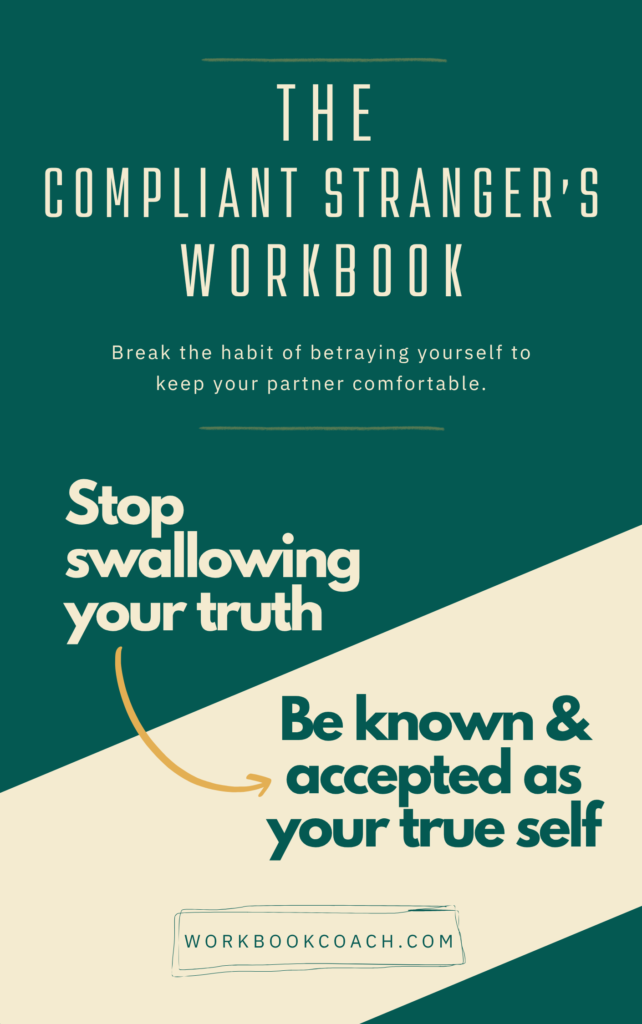
If you read this and felt a knot in your stomach, that reaction is information. The hardest part of these dynamics isn’t spotting them in your partner, it’s noticing how much of yourself you’ve quietly given up to keep the peace. The Compliance Workbook is built to help you catch the small self-betrayals and abandonment: the opinions you swallow and the ‘it’s fine’s you don’t mean, before they become your default. Start the workbook now and practice staying yourself, even when its uncomfortable.
Passive-Aggressive Sabotage
These behaviors let a partner avoid direct confrontation or an honest “no,” while still getting the outcome they want through frustration and exhaustion.
7. Weaponized Incompetence: Doing Something Badly on Purpose to Avoid Doing It Again
Weaponized incompetence is when someone deliberately does a task poorly, so their partner stops asking them to do it at all.
The classic example: household chores. They do the laundry wrong on purpose, or load the dishwasher so badly it has to be redone, until you just start doing it yourself to avoid the hassle.
This works because it shifts the labor back onto you without ever having to say no outright. It looks like incompetence, but it’s a strategic avoidance.
8. Weaponized Procrastination: Using Delay Tactics to Avoid Saying No
Weaponized procrastination is when a partner says yes to something, then repeatedly cancels, delays, or postpones, using excuses to wear you down until you stop asking.
They agree to help plan an event, meet your family, or handle a shared responsibility. Then it’s “next week,” then “I’m just really busy,” on repeat, until you give up expecting it to happen.
This pattern happens because directly saying no feels uncomfortable or makes them ‘the bad guy.’ Procrastination lets them avoid that discomfort while still getting out of the commitment, at your expense.
9. Contempt and Mockery: When “Just a Joke” Is Actually an Attack
Contempt shows up as passive-aggressive put-downs and subtle insults, often disguised as jokes, aimed at your character, appearance, or intelligence.
It sounds like: “I’m just teasing,” right after a comment that clearly stung. Little digs about your intelligence or choices in front of other people, always framed as humor if you push back.
Relationship researchers consistently identify contempt as one of the strongest predictors of relationship breakdown. It works slowly, chipping away at your confidence and self-image until the criticism starts to feel like truth.
Emotional Withholding
These patterns create chronic uncertainty, keeping you anxious, unsettled, and unsure of where you actually stand.
10. Broken Commitments and Chronic Unreliability in Relationships
This red flag shows up as a repeated failure to follow through on shared responsibilities, obligations, or promises, where words and actions consistently don’t match.
They promise to handle the bills, show up for important events, or follow through on plans, and consistently don’t. Each time, there’s a reasonable-sounding excuse so you wait and even make excuses for them.
One broken promise is human. A pattern of them is a sign that your partner’s word doesn’t mean anything, which forces you to carry the weight of the relationship’s logistics and trust alone.
11. The Hot-and-Cold Cycle That Keeps You Anxious
Intermittent reinforcement is a cycle of unpredictable affection, warm and attentive one moment, cold and distant the next, that keeps you anxious and constantly trying to earn back the good version of them.
Your partner may allow intense closeness and affection, followed by sudden withdrawal or coldness with no clear cause. Just when you start to pull away, they come back warm again, resetting the cycle.
This dynamic is powerful because unpredictable rewards are more addictive than consistent ones. You end up walking on eggshells, never knowing which version of them you’ll get. You chase the highs and dread the lows, which keeps you emotionally hooked even when the relationship isn’t good for you.
12. Stonewalling and the Silent Treatment: Using Withdrawal as Punishment
Stonewalling is a punitive withdrawal from conflict, shutting down, going silent, or physically leaving, used to punish, control, or avoid repair rather than resolve anything.
After a disagreement, instead of talking it through, they go completely silent for hours or days, refusing to engage until you apologize or give up on the issue entirely.
This is dangerous because it blocks any real resolution. Conflict is a normal part of relationships, but stonewalling turns it into a punishment, teaching you that raising concerns leads to being shut out rather than heard.
Choosing Yourself, Starting Now
It’s disappointing to realize a connection you invested in turned out to be unsafe or unhealthy. But staying stuck is far more costly than facing that truth. Recognizing these relationship red flags, whether it’s gaslighting, stonewalling, or emotional withholding, is the first real step toward healthier relationships and a stronger sense of self. Once you have the language to name what’s happening, you take your power back.
Healing from toxic relationship patterns isn’t about blame. It’s about awareness, boundaries, and choosing better, starting now. You deserve a relationship built on consistency, respect, and emotional safety.
If you recognize signs of abuse or feel unsafe in your relationship, please reach out to a licensed therapist, counselor, or a domestic violence support hotline in your area.